Responding to Disruptions in Funding: A case study from impact technology

OpenUp shares hard-won lessons on nonprofit funding resilience: Treat income as strategic, decentralize business development, balance grant and client revenue, explore pooled resources with partners, and build toward a cash reserve – illustrated by our own pivot from 74% grant-dependent to 86% client-funded.

The cancellation of RightsCon 2026, which was set to be hosted in Lusaka, Zambia, in early May, was a tremendous blow to the organising team and all organisations that were set to attend.

We have decided to share some of the content we were going to present as a panel and workshop at the conference as part of our activities for the Digital Democracy in Sub-Saharan Africa (DDISA) Fund. You can read our article discussing the cancellation here for more insight into digital sovereignty in Africa, or read more about the DDISA Fund here.

You can also access the full workshop here, of which reading this policy brief is the first activity.

Introduction

The nonprofit sector is frequently being encouraged to develop “resilience” and “diversify its income”. Yet, the practical guidance on how to build this resilience is often lacking, as are the funds that will actually facilitate building these forms of resilience. This case study provides some experience-based advice on how organisations might diversify their income, and how to reconsider your funding and income strategies more broadly.

...the practical guidance on how to build this resilience is often lacking, as are the funds that will actually facilitate building these forms of resilience.

We connect these general lessons to OpenUp’s own history of pivoting its funding strategy to help give a practical focus to the advice, but also so that the particularities of our context are very clear. 

The OpenUp Experience

As a non-profit that was established without an endowment in 2013, from OpenUp’s inception we relied very heavily on project-related philanthropic funds to do our work. Our co-founders had both a commercial and non-profit backgrounds, but the non-profit experience had historically been embedded in traditional philanthropy-focussed non-profit fundraising. Between 2017 to 2023 we were fortunate to receive core funds from Luminate, but these funds we largely structured around programmatic outputs, with some resources assigned in attempting to productise Wazimap, our GIS tooling solution

Our core funds were sunsetted in 2023, and our other significant funder – the Open Society Foundation of South Africa – was absorbed into OSF Africa. OSF Africa has not rebuilt the scale of its giving to the region, in spite of its restructuring occurring over quite a few years.

During 2022 we launched a new Funding Strategy for the periods 2022-2024 that focused on 1) Designing a funding strategy that supports our strategic aims; 2) Developing and maintaining income diversity for sustainability; and 3) Focussing on building a cash reserve for ensuring cash flow security. Given our successes, we launched a new Strategy for the 2025-2030 period. 

Between the financial years 2022-2023, and 2023-2024, we were able to pivot from an income split of 74% grant income and 26% client income, to 65% client income and 35% grant income. In addition, we only saw a total decline in income of less than 20%, in spite of the withdrawal of our two major funders that account for a total of over 45% of our total income. We had planned against a drop of over 30% income. This slight drop was followed by a further drop in 2024 – 2025, but this was finally a reflection of the fully withdrawn core support – we managed an 86% client income stream in that year.

Sustainability Strategies

Income, whether revenue or grant, should be viewed as a strategic asset for achieving a nonprofit's intended impact. As such, it should be driven by strategy which aligns to your overall impact goals, but also so it allows your whole organisation to be able to coordinate toward the same shared funding goals. It is important that business development is decentralised and organisation-wide, allowing more hands to lighten the load, and to access opportunities that may not be visible to a single, or small group, of organisational actors.

When we treat income as a strategic asset, it becomes clearer that different kinds of income require different strategies not just for sourcing them, but also for how to work with them, to ensure a nonprofit can use them as productively as possible for its organisational aims.

...different kinds of income require different strategies...

An example of how OpenUp have categorised these simply is seen through this “Spending Guide” table:
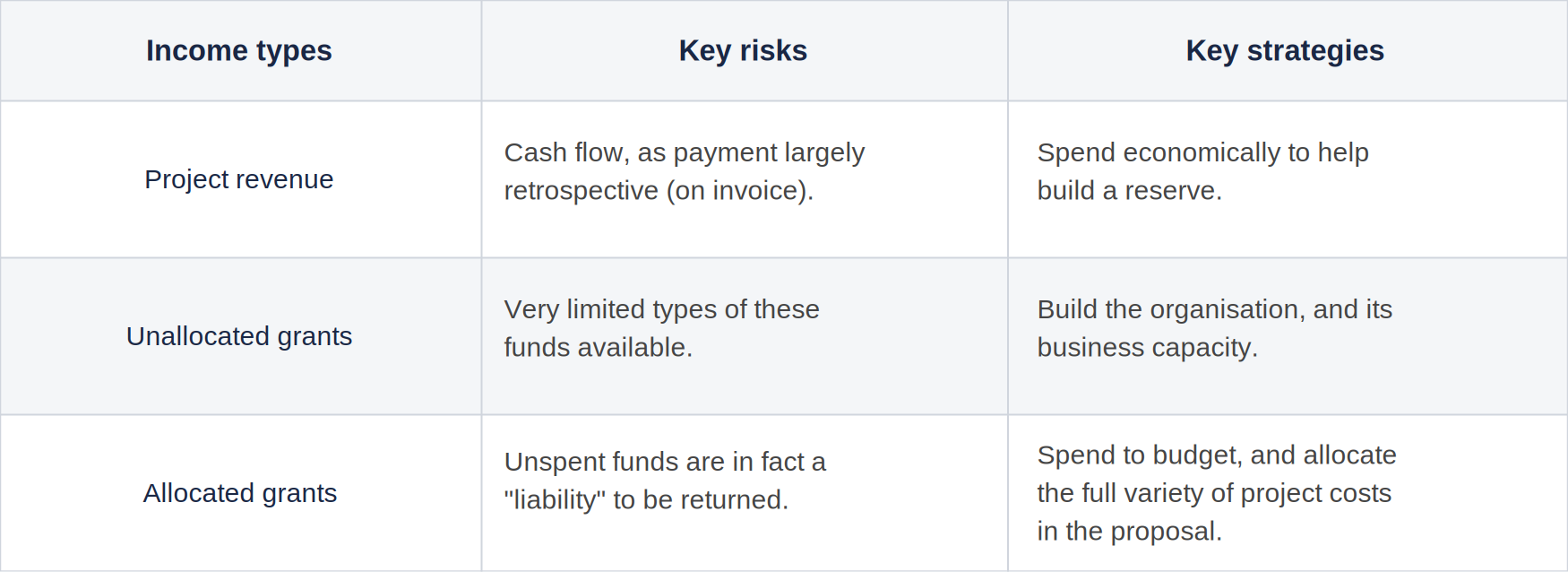
Diagram A: Table on main income types, their associated risks, and strategies for their spend.

Your Strategy also has to be shared by the organisation as a whole. When we launched our five-year Strategy, it was based on significant organisation-wide discussion (and fun data analytics). We also began an organisation-wide approach to fostering business – which can be facilitated as easily as through a weekly business development meeting (and in our case, a very active shared Bizdev Slack channel). Loading business development on to one team member (frequently in the non-profit space, the Executive Director), not only reduces the social and professional networks you are accessing, but also presents an organisational risk – business, because it is based so strongly on personal relationships, and often travels when people leave.

We also began an organisation-wide approach to fostering business – which can be facilitated as easily as through a weekly business development meeting...

The final point in favour of a written Strategy is based on the old adage, “You can’t manage what you don’t measure”. Providing targets within your Strategy helps you to work toward a shared target, and also gives you a way to contextualise success (or failure, which is also ok). Reporting on that Strategy to other people – which include the organisation but also your Board – provides an extra form of accountability to help you stay on track. In developing our own Strategy, to ensure we developed feasible targets, we found case studies very helpful. In these case studies we broke down the different ways we had brought in income in recent years, and unpacked what was good, and what was bad, about the experiences for each (clearly outlining where we could control outcomes, and where we couldn’t).

Building a Business

Building Resilience 

A Strategy requires a goal. You should be creating goals for your income that centre building your resilience in the longer term, especially given the volatility of the grant funding environment. Once you have these goals, you need to make sure you are structured to pursue them. Your project and organisational management processes must adapt to the different kinds of income you want to prioritise.

You should be creating goals for your income that centre building your resilience in the longer term...

So for instance, to ensure you can manage the challenges of cash flow that come with project income, you need to have systems in place that ensure you can have a strong foresight on future income realities. In fact, in an ideal world, you would build your project and revenue income strategies when you already have a cash reserve in place – as that reserve will assist with cash flow. You also want to make sure you are tracking your invoicing well, and preparing and distributing your invoices in good time – this often has implications for strengthening your project management practices, more generally. This is a real adaptation for organisations that have been focusing on managing grant income (see further in Diagram A).

Building resilience also means trying to keep lean on the organisational costs that don’t sufficiently contribute to your sustainability model. So for instance don’t invest in rent if your services are largely remotely offered; or don’t invest in local travel for conferences that can’t be allocated to specific projects, or that won’t contribute to future revenue. Think about your expenses, then, as strategically as you think about your income. 

And invest into business development. This means both making sure a number of staff have business development tasks as we mentioned earlier, but also means researching and understanding your business environment. Explore the potential of new income streams from the social economy you might not have considered before – like private philanthropy, high-net-worth individual donations, crowdsourcing, empowerment trusts, corporate social responsibility funds, etc. This segues us neatly into next considering what your different kinds of business or income could look like, in practice.

Your Value and Your Business

Firstly, it needs to be acknowledged that productisation as a form of income activity is not easy. Productisation, which centres on building income from a single technology project, is often touted by the philanthropy community as a solution to diversifying funding for the more innovation-forward nonprofits. However, building a market around a single product requires strong marketing and business development resources, as well as staffing devoted to building only that product. For resource constrained nonprofits, with broad goals, this can be inefficient (especially when contextualised against the amount of revenue that can actually be charged against a single product in market). It is, however, an income stream.

In our experience a better strategy for considering new income streams is to focus on the human resources you have, and centre your current specific value additions as what you “market”. For many nonprofits, this highlights services like training, community-building, and context-specific research – and implicates thinking creatively of the kind of entities that may be willing to pay for these great additions. 

...a better strategy for considering new income streams is to focus on the human resources you have...

Particularly in the non-profit sector, people undervalue the expertise and special skills they have, because our non-profit mindset means we don’t commodify what we do. But there is an opportunity to build business through what you already know well, which also means you don’t have to get new resources in to do it (ie. Are you strong at training? Are you good at logistics? Do you have assets that are useful to others?). The challenge for non-profits though is how to do that ‘selling’ without exploiting the beneficiaries you want to serve. 

But an additional challenge is that it's very difficult to acclimatise a market to paying for something you may have provided for free before. OpenUp has found that thinking about how those with resources can help subsidise the services we provide to those we would never want to charge can be a motivating framing. The interesting truth is that, in our experience, people often don’t like non-profits trying to act as businesses. And honestly it is hard to balance the priorities of our organisation with clients who have become very used to grant funds subsidising the kinds of help we are able to give. But that's why it's so important to build a community with trust and honesty, because – if we can show how we are working together to advance the communities we love – finding a way to do it together, with no party feeling exploited, is absolutely possible.

Exploring Other Income

Balancing Business with Grants

Our experience in moving to focusing more on client income has taught us something very interesting, though perhaps obvious – the pursuit of grant funding should be driven by different framings from those you use in the pursuit of business, or revenue, clients.

Philanthropies want to invest in impact (along with some impact investors too), and you thus need to be able to do that. A strong Theory of Change, and strong impact measurement, help you to tell that story well to potential funders.

A strong Theory of Change, and strong impact measurement, help you to tell that story well to potential funders.

With your business clients, at least in our experience, the question is not about “Why fund us?”, but rather “Why pay us?”. In other words, it is much more strongly focused on your particular value proposition, and framing what your unique contribution is.

These two pursuits are not necessarily conflicting or competing – ideally in an organisation that is starting to pursue diversified funding, you do both simultaneously, and naturally. But they are not necessarily always the same thing – and understanding how your organisation could frame each of these ideas, clearly, is an important step in your business journey.
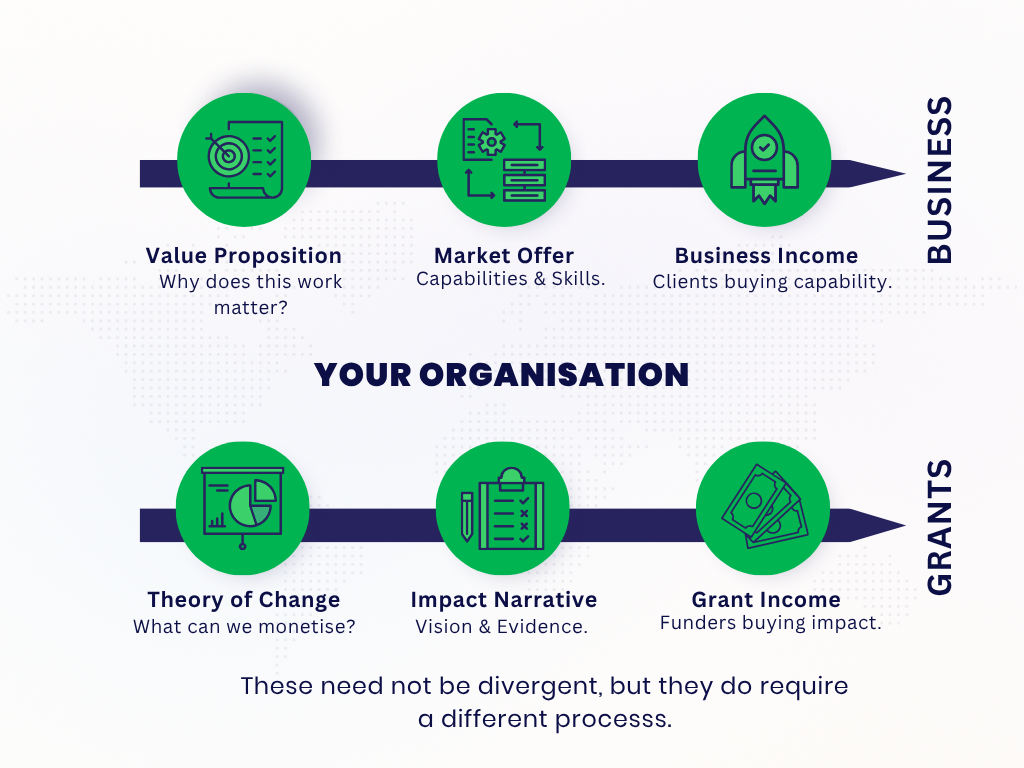
Diagram B: An outline of the two different income pathways.

Consortiums and Partnerships

Consortiums are an important opportunity to try and access grant funds at scale. Consortia help us spread risk, access larger pools of funding, and leverage different partners' strengths so that we appeal to a broader range of funders and improve our potential for impact. It's also just great to collaborate: but you must acknowledge that the collaboration itself is half the work. This is why project management and collaboration can be included as specific impact areas within your actual project design, so that you are measuring actual collaboration, as you implement it on your project. This may even result in new kinds of formal partnerships, and even full mergers of organisations.

Consortia help us spread risk, access larger pools of funding, and leverage different partners' strengths so that we appeal to a broader range of funders and improve our potential for impact.

New partnerships can offer you new avenues for income. For instance, we have collaborated with for-profit entities, when our values align, to access tenders designed for for-profit businesses. And we have supported like-minded for-profits in accessing income through the subcontracting grants that are relevant to our shared goals.

Collaboration and Pooling

There are also more creative ways that we can collaborate and pool resources, to enhance sustainability. One method for this is for nonprofits to pool a broad array of assets, and not just focus on shared funding as above. Organisations can leverage each other's human resources – there are functional areas of staffing that can be applied across organisations, like administration and logistics, to help share costs. Assets like buildings and hardware can be shared. These creative forms of pooled resources require nonprofits to invest in networking and stakeholder development, and also requires strong communication skills. Building networks is important both for enhancing our impact, but also improving our potential organisational sustainability. 

This brief was prepared by OpenUp as part of our activities under the Digital Democracy Innovation in Sub-Saharan Africa Fund.

References

Share this post:
Email iconTwitter icon

OpenUp shares hard-won lessons on nonprofit funding resilience: Treat income as strategic, decentralize business development, balance grant and client revenue, explore pooled resources with partners, and build toward a cash reserve – illustrated by our own pivot from 74% grant-dependent to 86% client-funded.

The cancellation of RightsCon 2026, which was set to be hosted in Lusaka, Zambia, in early May, was a tremendous blow to the organising team and all organisations that were set to attend.

We have decided to share some of the content we were going to present as a panel and workshop at the conference as part of our activities for the Digital Democracy in Sub-Saharan Africa (DDISA) Fund. You can read our article discussing the cancellation here for more insight into digital sovereignty in Africa, or read more about the DDISA Fund here.

You can also access the full workshop here, of which reading this policy brief is the first activity.

Introduction

The nonprofit sector is frequently being encouraged to develop “resilience” and “diversify its income”. Yet, the practical guidance on how to build this resilience is often lacking, as are the funds that will actually facilitate building these forms of resilience. This case study provides some experience-based advice on how organisations might diversify their income, and how to reconsider your funding and income strategies more broadly.

...the practical guidance on how to build this resilience is often lacking, as are the funds that will actually facilitate building these forms of resilience.

We connect these general lessons to OpenUp’s own history of pivoting its funding strategy to help give a practical focus to the advice, but also so that the particularities of our context are very clear. 

The OpenUp Experience

As a non-profit that was established without an endowment in 2013, from OpenUp’s inception we relied very heavily on project-related philanthropic funds to do our work. Our co-founders had both a commercial and non-profit backgrounds, but the non-profit experience had historically been embedded in traditional philanthropy-focussed non-profit fundraising. Between 2017 to 2023 we were fortunate to receive core funds from Luminate, but these funds we largely structured around programmatic outputs, with some resources assigned in attempting to productise Wazimap, our GIS tooling solution

Our core funds were sunsetted in 2023, and our other significant funder – the Open Society Foundation of South Africa – was absorbed into OSF Africa. OSF Africa has not rebuilt the scale of its giving to the region, in spite of its restructuring occurring over quite a few years.

During 2022 we launched a new Funding Strategy for the periods 2022-2024 that focused on 1) Designing a funding strategy that supports our strategic aims; 2) Developing and maintaining income diversity for sustainability; and 3) Focussing on building a cash reserve for ensuring cash flow security. Given our successes, we launched a new Strategy for the 2025-2030 period. 

Between the financial years 2022-2023, and 2023-2024, we were able to pivot from an income split of 74% grant income and 26% client income, to 65% client income and 35% grant income. In addition, we only saw a total decline in income of less than 20%, in spite of the withdrawal of our two major funders that account for a total of over 45% of our total income. We had planned against a drop of over 30% income. This slight drop was followed by a further drop in 2024 – 2025, but this was finally a reflection of the fully withdrawn core support – we managed an 86% client income stream in that year.

Sustainability Strategies

Income, whether revenue or grant, should be viewed as a strategic asset for achieving a nonprofit's intended impact. As such, it should be driven by strategy which aligns to your overall impact goals, but also so it allows your whole organisation to be able to coordinate toward the same shared funding goals. It is important that business development is decentralised and organisation-wide, allowing more hands to lighten the load, and to access opportunities that may not be visible to a single, or small group, of organisational actors.

When we treat income as a strategic asset, it becomes clearer that different kinds of income require different strategies not just for sourcing them, but also for how to work with them, to ensure a nonprofit can use them as productively as possible for its organisational aims.

...different kinds of income require different strategies...

An example of how OpenUp have categorised these simply is seen through this “Spending Guide” table:

Diagram A: Table on main income types, their associated risks, and strategies for their spend.

Your Strategy also has to be shared by the organisation as a whole. When we launched our five-year Strategy, it was based on significant organisation-wide discussion (and fun data analytics). We also began an organisation-wide approach to fostering business – which can be facilitated as easily as through a weekly business development meeting (and in our case, a very active shared Bizdev Slack channel). Loading business development on to one team member (frequently in the non-profit space, the Executive Director), not only reduces the social and professional networks you are accessing, but also presents an organisational risk – business, because it is based so strongly on personal relationships, and often travels when people leave.

We also began an organisation-wide approach to fostering business – which can be facilitated as easily as through a weekly business development meeting...

The final point in favour of a written Strategy is based on the old adage, “You can’t manage what you don’t measure”. Providing targets within your Strategy helps you to work toward a shared target, and also gives you a way to contextualise success (or failure, which is also ok). Reporting on that Strategy to other people – which include the organisation but also your Board – provides an extra form of accountability to help you stay on track. In developing our own Strategy, to ensure we developed feasible targets, we found case studies very helpful. In these case studies we broke down the different ways we had brought in income in recent years, and unpacked what was good, and what was bad, about the experiences for each (clearly outlining where we could control outcomes, and where we couldn’t).

Building a Business

Building Resilience 

A Strategy requires a goal. You should be creating goals for your income that centre building your resilience in the longer term, especially given the volatility of the grant funding environment. Once you have these goals, you need to make sure you are structured to pursue them. Your project and organisational management processes must adapt to the different kinds of income you want to prioritise.

You should be creating goals for your income that centre building your resilience in the longer term...

So for instance, to ensure you can manage the challenges of cash flow that come with project income, you need to have systems in place that ensure you can have a strong foresight on future income realities. In fact, in an ideal world, you would build your project and revenue income strategies when you already have a cash reserve in place – as that reserve will assist with cash flow. You also want to make sure you are tracking your invoicing well, and preparing and distributing your invoices in good time – this often has implications for strengthening your project management practices, more generally. This is a real adaptation for organisations that have been focusing on managing grant income (see further in Diagram A).

Building resilience also means trying to keep lean on the organisational costs that don’t sufficiently contribute to your sustainability model. So for instance don’t invest in rent if your services are largely remotely offered; or don’t invest in local travel for conferences that can’t be allocated to specific projects, or that won’t contribute to future revenue. Think about your expenses, then, as strategically as you think about your income. 

And invest into business development. This means both making sure a number of staff have business development tasks as we mentioned earlier, but also means researching and understanding your business environment. Explore the potential of new income streams from the social economy you might not have considered before – like private philanthropy, high-net-worth individual donations, crowdsourcing, empowerment trusts, corporate social responsibility funds, etc. This segues us neatly into next considering what your different kinds of business or income could look like, in practice.

Your Value and Your Business

Firstly, it needs to be acknowledged that productisation as a form of income activity is not easy. Productisation, which centres on building income from a single technology project, is often touted by the philanthropy community as a solution to diversifying funding for the more innovation-forward nonprofits. However, building a market around a single product requires strong marketing and business development resources, as well as staffing devoted to building only that product. For resource constrained nonprofits, with broad goals, this can be inefficient (especially when contextualised against the amount of revenue that can actually be charged against a single product in market). It is, however, an income stream.

In our experience a better strategy for considering new income streams is to focus on the human resources you have, and centre your current specific value additions as what you “market”. For many nonprofits, this highlights services like training, community-building, and context-specific research – and implicates thinking creatively of the kind of entities that may be willing to pay for these great additions. 

...a better strategy for considering new income streams is to focus on the human resources you have...

Particularly in the non-profit sector, people undervalue the expertise and special skills they have, because our non-profit mindset means we don’t commodify what we do. But there is an opportunity to build business through what you already know well, which also means you don’t have to get new resources in to do it (ie. Are you strong at training? Are you good at logistics? Do you have assets that are useful to others?). The challenge for non-profits though is how to do that ‘selling’ without exploiting the beneficiaries you want to serve. 

But an additional challenge is that it's very difficult to acclimatise a market to paying for something you may have provided for free before. OpenUp has found that thinking about how those with resources can help subsidise the services we provide to those we would never want to charge can be a motivating framing. The interesting truth is that, in our experience, people often don’t like non-profits trying to act as businesses. And honestly it is hard to balance the priorities of our organisation with clients who have become very used to grant funds subsidising the kinds of help we are able to give. But that's why it's so important to build a community with trust and honesty, because – if we can show how we are working together to advance the communities we love – finding a way to do it together, with no party feeling exploited, is absolutely possible.

Exploring Other Income

Balancing Business with Grants

Our experience in moving to focusing more on client income has taught us something very interesting, though perhaps obvious – the pursuit of grant funding should be driven by different framings from those you use in the pursuit of business, or revenue, clients.

Philanthropies want to invest in impact (along with some impact investors too), and you thus need to be able to do that. A strong Theory of Change, and strong impact measurement, help you to tell that story well to potential funders.

A strong Theory of Change, and strong impact measurement, help you to tell that story well to potential funders.

With your business clients, at least in our experience, the question is not about “Why fund us?”, but rather “Why pay us?”. In other words, it is much more strongly focused on your particular value proposition, and framing what your unique contribution is.

These two pursuits are not necessarily conflicting or competing – ideally in an organisation that is starting to pursue diversified funding, you do both simultaneously, and naturally. But they are not necessarily always the same thing – and understanding how your organisation could frame each of these ideas, clearly, is an important step in your business journey.

Diagram B: An outline of the two different income pathways.

Consortiums and Partnerships

Consortiums are an important opportunity to try and access grant funds at scale. Consortia help us spread risk, access larger pools of funding, and leverage different partners' strengths so that we appeal to a broader range of funders and improve our potential for impact. It's also just great to collaborate: but you must acknowledge that the collaboration itself is half the work. This is why project management and collaboration can be included as specific impact areas within your actual project design, so that you are measuring actual collaboration, as you implement it on your project. This may even result in new kinds of formal partnerships, and even full mergers of organisations.

Consortia help us spread risk, access larger pools of funding, and leverage different partners' strengths so that we appeal to a broader range of funders and improve our potential for impact.

New partnerships can offer you new avenues for income. For instance, we have collaborated with for-profit entities, when our values align, to access tenders designed for for-profit businesses. And we have supported like-minded for-profits in accessing income through the subcontracting grants that are relevant to our shared goals.

Collaboration and Pooling

There are also more creative ways that we can collaborate and pool resources, to enhance sustainability. One method for this is for nonprofits to pool a broad array of assets, and not just focus on shared funding as above. Organisations can leverage each other's human resources – there are functional areas of staffing that can be applied across organisations, like administration and logistics, to help share costs. Assets like buildings and hardware can be shared. These creative forms of pooled resources require nonprofits to invest in networking and stakeholder development, and also requires strong communication skills. Building networks is important both for enhancing our impact, but also improving our potential organisational sustainability. 

This brief was prepared by OpenUp as part of our activities under the Digital Democracy Innovation in Sub-Saharan Africa Fund.

References